
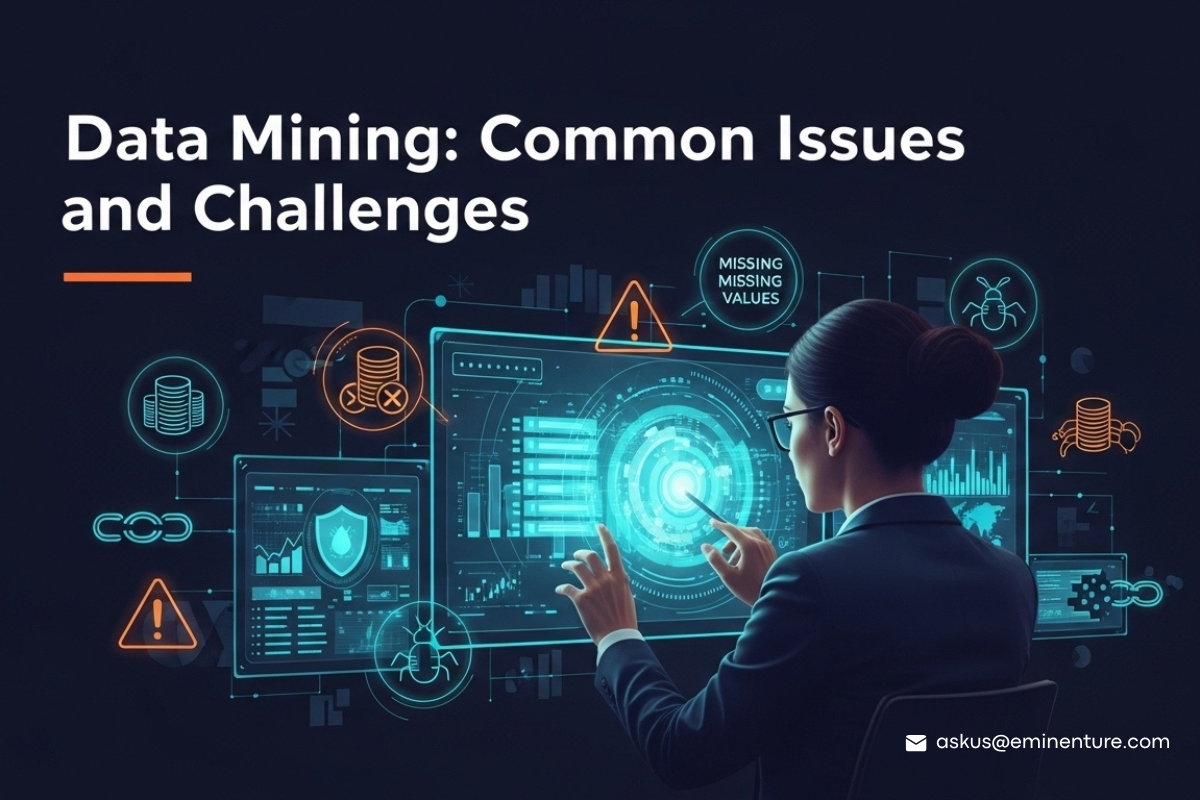
What Are Data Mining Issues?
-
 EM Admin
- 0 Comments
Mining means digging out something valuable. In today’s data‑driven world, nothing can be more rewarding than data mining. It’s one of the best practices for extracting value and insights from huge datasets.
But let’s face reality—data mining is not always sunshine. Certainly, golden opportunities lie in data‑driven strategies. And the data mining process reveals them. So, businesses must address major issues in data mining. These challenges range from privacy concerns to algorithmic bias and scalability problems.
Data mining requires a structured ETL process—Extract, Transform, and Load—to move from raw data to meaningful insights that help detect bottlenecks, gaps in efficiency, or even lost opportunities.
Recognizing what the major issues in data mining are crucial.
Data Mining Risks & Threats
Let’s explore these problems in this process.
1. Privacy Concerns: The Foremost Data Mining Problem
One of the most significant challenges in data mining is privacy. Have you seen how Spotify automatically shows your favourite songs in its playlist? But have you ever thought of how it does? Is it listening to what you say? Going beyond music, it is capable of understanding your moods, trends, and even social connections.
Well, it’s the magic of data mining AI or algorithms that continue to extract, transform, and load the complementary data so that its machine learning algorithms can understand your psychology. It’s similar to the backlash that Facebook faced when the Cambridge Analytica case revealed how easy it is to exploit personal data for political campaigns.
The gist of this explanation is the privacy concern. It’s the foremost threat that is still threatening the privacy of people who use social media, e-commerce platforms, and streaming applications. Companies are using online usage data to anticipate the behaviour of users, which sounds creepy. A report by the Pew Research Centre unveiled that 79% of Americans are distressed over how companies peek into their personal data.
Use Case:
Ecommerce giant Amazon counts on this process to fuel its recommendation algorithms by using past purchase data. Though it’s insightful and an innovative idea, it comes at the cost of the privacy of searches. Don’t online ads dictate by using this mining method? You'd better understand.
2. Data Quality Issues: Garbage In, Garbage Out
Did you know that bad data costs a lot? According to IBM (IBM Big Data Hub), it costs companies a whopping over $3.1 trillion every year in the US.
This fact clearly indicates the next data mining issue, which is the bad quality. It represents noise, which can be messy, incomplete, inaccurate or obsolete data. Every smart individual can understand that flawed data breeds wrong insights. What if mission-critical industries consume and use it for decisions and recommendations? It actually happened in 2023 when an AI-driven healthcare tool inaccurately examined a patient’s health because of poor-quality data. This data was incomplete and noisy, which led to inaccurate predictions. This is where technology failed because of bad data in its backend.
Use Case:
Banks are aggressively using data mining tools these days to anticipate loan defaulters. If these tools acquire bad quality data, the mining result will end up in rejecting eligible applicants for loans. Thanks to advanced AI techniques that remove risks associated with imperfect mining.
3. Algorithm Bias: When AI Plays Favorites
Algorithms act like our neural system to a certain extent, but not exactly. They are as good as the trained employees. Now, think of the case where the data has biases. Its impact can be seen in algorithms also. They won’t produce fair results. The outcome can be disastrous sometimes.
Use Case:
Amazon’s AI tool for onboarding faced negative criticism as it was discovered that the tool biases against women, as this link suggests. The data models were driven by past hires, which excluded the applicants who were not from a male-dominated workforce category. It was trained in this way. So, bias is also a big concern and gap when you use AI for data cleansing.
4. Scalability Challenges: Handling Massive Data
Did you have any idea about what amount of data we produce? Yes, this is the next data mining concern, which is scalability. Global data creation is exploding, with an expected 463 exabytes generated each year by 2025 (World Economic Forum). Let’s share another case of Netflix, which streams 212 million movies in HD every single day. Simply put, the processing of this much data has become a daunting task. It requires cutting-edge tools and technologies and constant optimisation to avoid lags and irregularities in suggestions.
Use Case:
Telecom giants like AT&T rely on mining to anticipate network issues. However, scaling up mining processes in real time by collecting scaling data via AI. It remains one of the biggest concerns in data mining.
5. Interpretability: Decoding the Black Box
Did you know about the black box? It’s the device that can easily answer why without explaining how. Data mining is struggling with complex algorithms and machine learning models that act no less than a black box. This lack of interpretability is a challenge, especially when the decisions lead to critical consequences.
Use Case:
Let’s consider the case of hedge funds that use AI-driven trading systems for laser-fast decisions. In 2022, an unexplained fluctuation slashed the stock market. This case can happen with the healthcare industry, which highlights the risk of systems that themselves are not able to fully understand the data.
6. Legal and Ethical Challenges: Navigating the Grey Areas
The inception of GDPR in Europe was a surprising emergence, forcing companies to be transparent about data usage and practices. This regulation pressed many companies to reveal and limit data collection, secure storage, and usage of sensitive data. Initially, and even today, businesses struggle to comply. Hefty fines and penalties are like unbearable backlash.
Use Case:
Many ride apps like Uber rely on data mining services for optimizing routes and connecting riders with drivers. But sometimes, the data is manipulated, and the route leads to strange places. It leads to legal issues, as the European Commission GDPR suggests.
7. Cybersecurity Risks: A Goldmine for Hackers
Data mining is concerned with crucial details, which cyber attackers often look for. For being a key to unlock many insights and strategies, they breach and take it away for monetary benefits. The loser, on the other hand, faces financial and reputational damage.
Use Case:
In 2024, Synnovis, a laboratory services provider for the NHS, faced a ransomware attack costing £32.7 million and leaking 400 GB of sensitive data. To read more, click here. Likewise, online merchants face similar data mining risks and threats in protecting mined data from hackers.
Why Addressing Data Mining Issues Matters?
In a nutshell, the data mining process empowers businesses with insights that guide them in planning feasible actions. So, the existence of actionable plans depends on your expertise to address major flaws in data mining, which range from privacy to scalability. The frequency of faulty decisions and severe consequences can be minimized once you start considering these issues seriously.
Overall, this knowledge discovery or business intelligence process, when done right, introduces you to flexible strategies and hidden opportunities. So, you must be vigilant about these issues and challenges in data mining so it can be leveraged fully to make data-driven, actionable decisions confidently.
Conclusion
Certainly, data mining is an insightful tool that can reveal untapped and hidden strategies that can be innovative and ruling. It gives you the power to predict on the basis of the likelihood of data subjects. But there are concerns like security, bias, ethical issues, interpretability, scalability, and data quality that can make you think twice before believing in data-driven predictions or solutions.
.jpg)
.jpg)
.jpg)
.jpg)
.jpg)
Post Comment
Your email address will not be published. Required fields are marked *