

Data Science Offers Knowledge To Foresee & Adapt Future

Data science is the most fascinating discovery of breakthroughs using statistics, scientific methods, and data analysis to extract value.
The practitioner of data science is known as a data scientist, who has skills ranging from analyzing, data collecting, extracting, and deriving knowledge from multiple sources to achieve a goal.
How Does It Work?
It is the most interesting domain, wherein scientists and professionals involved in data science services drill a massive number of datasets to assess and take out something really valuable. This valuable knowledge discovery proves remarkable in anticipating future trends, winning strategies, engaging customers across different platforms, and opting for the future. Data science components ensure its smooth processing.
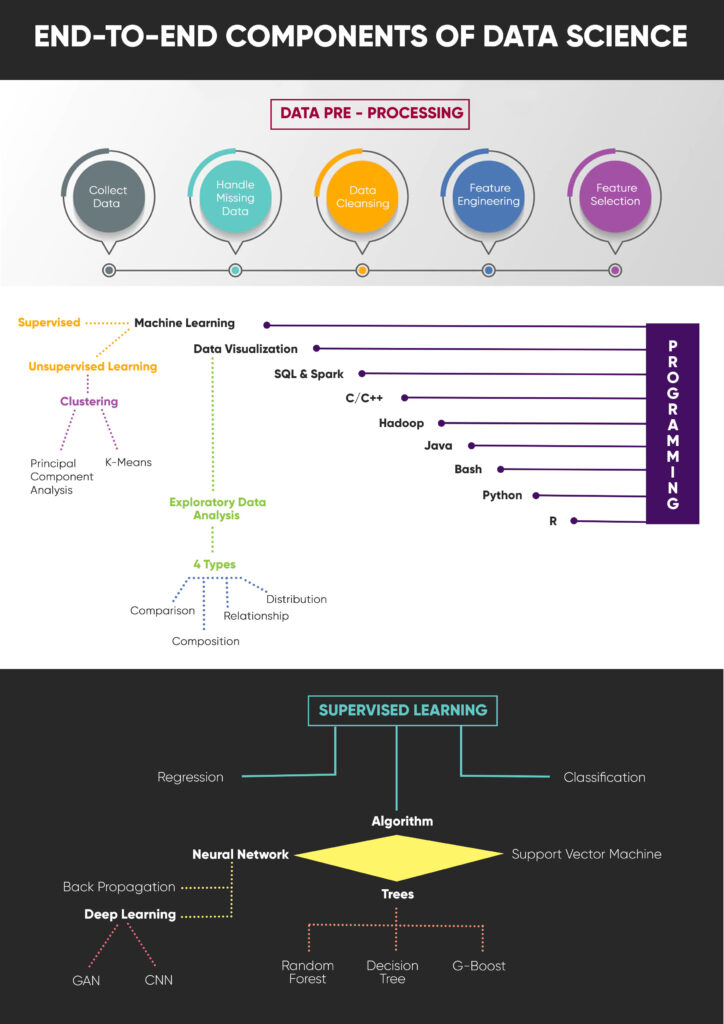
We have data floating all around in sensors, computers, mobile phones, smart devices, and applications. Despite the fact that almost 90 percent of data is created in less than a decade, there is a massive pool of it that is yet to be touched for deriving knowledge.
This data science works on the collected records from offline and online sources to store in the virtual server space or hardware. This collection is then put into advanced extraction tools to get information pertaining to a goal or what is likely to discover. Sometimes, this process is customized through scripts in Python or any other advanced language for separating desirable datasets.
Later on, cleaning is done by removing inconsistencies, invalid data entries, and duplicates manually or using applications. Subsequently, machine learning comes in a key role to see what can be discovered from the gathered databases.
This is where data analysts and scientists put innovation at work to get a substantial breakthrough. This entire process is called knowledge discovery development (KDD).
Difference Between Data Science, Artificial Intelligence (AI) and Machine Learning (ML)
- Data Science-Data science is a part of AI, which assists in extracting something meaningful from data that get to achieving incorporated business or any other goal.
- AI– It is a broader term, covering data science, machine learning, and deep learning. Simply put, it’s a revolutionary way of making computers think and behave like a human. It actually helps in transforming businesses, which was challenging before.
- Machine Learning – It is also a part of AI, which helps in figuring out knowledge or valuable information from the collected records.
- Deep Learning-This part of machine learning enables systems to sort out more complex problems.
What Steps Are Involved in Conducting Data Science?
The flow of this science runs towards modeling or deriving patterns. Here are the steps that make its lifecycle complete:
- Planning- It comprises defining the project and projecting outputs.
- Data Modeling – This step involves the use of a variety of open-source libraries or in-database tools to draw ML models. It generally requires APIs to ingest records, do profiling and visualize insights. Certainly, this is carried out with the right tools and access to relevant datasets and other resources.
- Measuring Models- Also known as model evaluation, the measuring of models helps in generating a comprehensive suite of evaluation metrics and visualization. This is how scientists analyze ML model performance against new sets of data and assign rank accordingly over time. This practice ensures enabling optimal behavior in production while keeping the expected baseline behavior of models.
- Automating Models- This step emphasizes explaining the internal mechanics of the output of ML models. It is important because ML works towards automating businesses or workflow, which needs generating predictive models that are self-explanatory.
- Deploying Models- This step is all about putting ML models into operations that are scalable and have secure APIs.
- Monitoring – Deploying is not the end of the process. It needs proper monitoring because these models are unable to ensure that they are accurately performing. Apart from that, there are possibilities that the model becomes obsolete or irrelevant as per future predictions over time. This is why monitoring is essential.
What are the Benefits of Data Science?
Since when this science is evolved, market or business research taps more accurate results. The collected information shows no redundancy. It even ensures the sharing of innovative ideas via codes, results, and reports, which tells how to remove bottlenecks in the workflow.
In addition, there are many advantages that one can have using it:
- One can study a large volume of a variety of datasets with ease.
- The intelligence or knowledge it taps is bias-free, auditable, and reproducible.
- It helps in figuring out such models that are way faster, trustful, and have less scope for failure.
There are many benefits that one can access using intelligence driven by data scientists, engineers, and ML specialists. This is why this platform market is expected to grow rapidly and reach USD385 billion by 2025.


Post Comment
Your email address will not be published. Required fields are marked *