

What Is Knowledge Process Outsourcing (KPO) & Its Benefits?

Did you know why 70% of companies hire outsourcing companies for data solutions? Deloitte’s 2022 report has discovered that it powers their decision-making mechanism. Knowledge Process Outsourcing (KPOs) is behind this success.
So, are you curious to learn what the KPO is? Let’s introduce you to this outsourcing concept.
Knowledge Process Outsourcing (KPO)?
Knowledge Process Outsourcing is an expanded form of KPO, which is related to contracting with a third-party professional (which can be a company or qualified specialists). According to the contract, service-seeking businesses delegate high-level or knowledge-intensive tasks to the outsourcing company.
Unlike standard business process outsourcing, KPOs delve into complex logical processes. In 2026, KPOs provide solutions beyond general knowledge, offering niche intelligence in ESG (Environmental, Social, and Governance) and legal tech as hyper-specialised entities. That’s why the demand for specialised solutions from KPOs is increasing.
Their processes require expertise in advanced analytical skills, domain expertise, and decision-making capabilities. High-value, data-driven solutions, for instance data mining, analysis, cleansing, scraping, and predictive models, need technical qualifications with hands-on experience. A KPO acquires talents to provide these solutions that not all outsourcing companies are able to provide.
5 Technical Types of KPO and Key Service Areas
Here is a comprehensive guide to understanding which type of KPO does what.
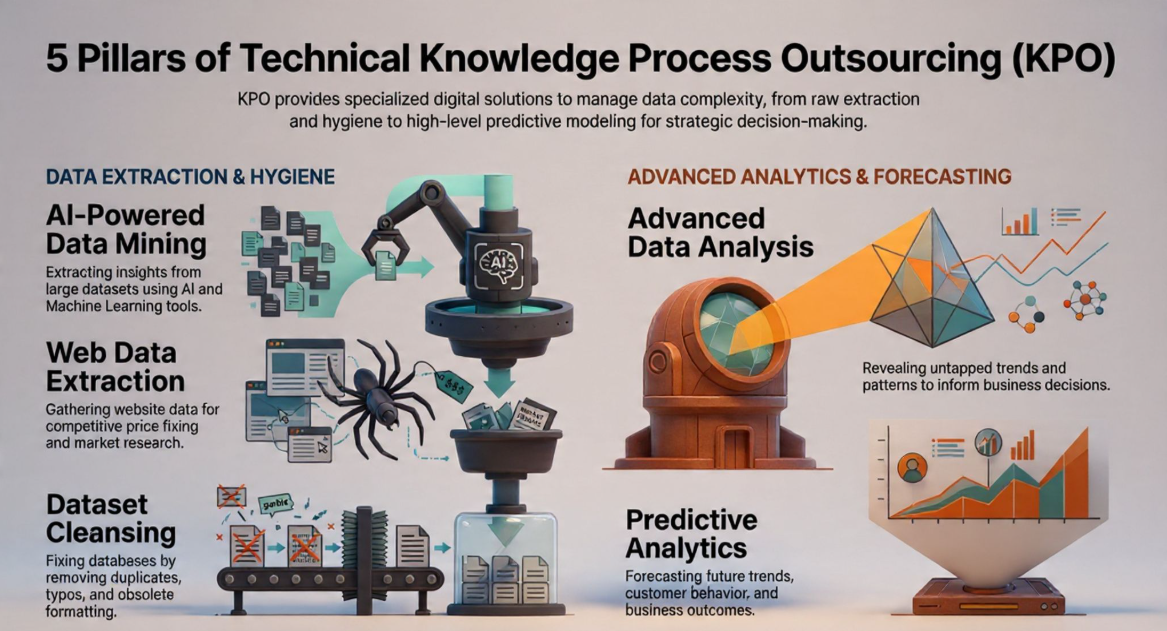
Here come the digital solutions that are actually complex and need KPOs to assist in addressing the complexities involved.
1. Data Mining: Data mining technically represents the practice of extracting valuable insights into large datasets. If the volume of data is large or scalable, it requires tools. KPOs deploy AI- and ML-powered tools to deal with big data.
2. Advanced Data Analysis: The insights require someone to understand it. Its comprehensibility reveals untapped trends and patterns for machine learning and business decisions.
3. Cleansing Datasets or Files: It is typically the practice of data hygiene, which is about combing out imperfections, such as dupes, typos, missing details, formatting issues, abbreviations, obsolete data, etc. This practice helps in fixing databases and making them ready to use.
4. Web Data Extraction: It’s like drawing insightful datasets from websites and digital sources to address business problems, like price data extraction for competitive price fixing and doing market research.
5. Predictive Analytics: This is also a type of assessment that ends up in forecasting future trends, customer behaviour, and business outcomes.
Strategic Advantages of KPO in the AI-Driven Era
Now that you’ve learnt what KPOs and their key areas are, let’s show you the many benefits of knowledge process outsourcing.
1. Access to Advanced Expertise
KPOs are knowledge discovery centres where advanced tools and techniques are used by upskilled specialists. With the advent of AGI, machine learning, and data science, these outsourcing entities stay equipped with cutting-edge tools and technologies with technical experts.
2. Maximum Cost Efficiency
By delegating intelligence- and analysis-based tasks, beneficiary businesses save all the money that might be invested in hiring, training, and retaining highly skilled professionals as in-house teams. So, this practice saves up to 30-40% of money in operations.
3. Concentrate on Main Functions
By delegating non-core, yet crucial, intelligence-based tasks to KPOs, businesses derive precious time to foster better opportunities and innovation and, hence, improve revenues.
4. Agile Scalability
KPO services assist in embracing market changes and demand fluctuations. Let’s take a case where a retail company finds a reliable source to scale up its sales data processing. Simultaneously, it focuses on how to increase sales without splitting its attention.
5. Improved Data Quality and Accuracy
Gartner 2021 reported that bad data quality leads to compromising on an average of $12.9 million annually. The knowledge process outsourcing service providers invest in advanced AI & ML tools to ensure the ingestion of clean records.
6. Faster Processing for Insights
The AI-driven automation and expertise can help in reaching insights and business solutions faster. The swift decisions help in making insightful decisions for back-office operations in a timely manner.
Real-World Examples of KPO in Action
1. Finance Sector
Frauds, especially credit card scams, are pervasive. With an outsourcing company in place, a bank can find genuine loan applicants via credit risk analysis using AI, which eventually prevents a hefty loss.
2. Manufacturing Industry
A manufacturing company can foresee when its equipment is going to break down. Some of the qualified analysts can study the previous records for predictive maintenance, decreasing downtime by up to 30% or more.
Potential Disadvantages of Knowledge Process Outsourcing (KPO)
As benefits are vast, you cannot ignore the demerits of KPOs.
1. Data Security and Privacy Risks
Sharing sensitive datasets with a third party can be threatening. It can expose your sensitive customer details if compliance is not strictly met.
2. Loss of Direct Control
You may lose control over data quality and timeliness if the partner is not vetted.
3. Structural Dependency
Over-reliance on an external partner for pricing details or scraping can lead to a shutdown or downturn if the outsourcing partner faces issues.
4. Hidden Costs
Despite being cost-effective, KPOs can impose additional charges for contract management, communication, or premium tools. These uninformed costs can cause a major loss.
5. Intellectual Property (IP) Risks
Many compliance issues are observed in the case of outsourcing, especially in data and technology. Handing over knowledge-intensive tasks can expose sensitive data to scammers if confidentiality agreements are breached.
Power your business with AI-driven KPO services for smarter decisions, faster processes, and scalable growth.
The Modern KPO Process: How It Works
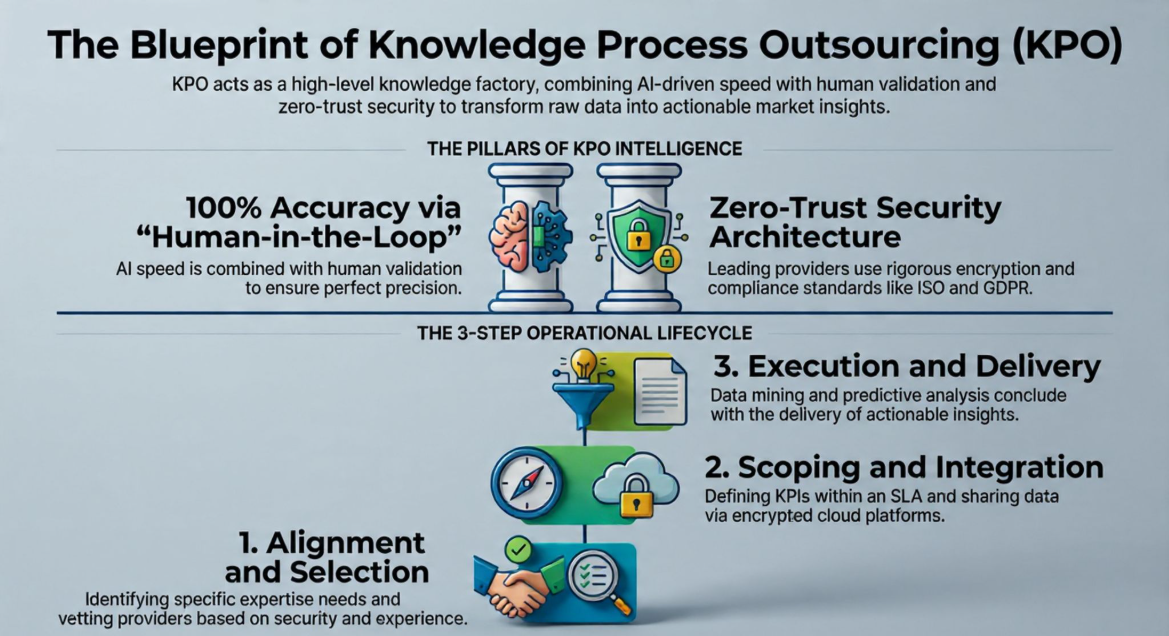
A KPO is like a knowledge factory where high-level intelligence-based tasks are delegated to specialised service providers. For achieving desired results, they meticulously leverage AI speed with “human-in-the-loop” (HITL) validation, which offers 100% accuracy. Additionally, some leading KPOs use “zero-trust architecture” for data sharing. So, here is how a KPO works:
1. Identifying Needs: The process is understood so that specialised knowledge, expertise, and advanced technology can be aligned.
2. Selecting a KPO Provider: Companies observe security measures, compliance with regulations (ISO/GDPR), and previous customer experience. This observation helps in evaluating and then selecting a KPO provider.
3. Defining Scope (SLA): The business and KPO company discuss the scope of work, deliverables, timeliness, and key performance indicators (KPIs).
4. Data Integration: Once the SLA is signed, the beneficiary company starts sharing relevant data through encrypted cloud-based platforms.
5. Execution & Delivery: The workflow for data mining or predictive analysis begins, concluding with the delivery of actionable market insights.
Conclusion
In the era of AI and digital transformation, KPO has become a strategic enabler for businesses seeking to harness the power of data. By outsourcing knowledge-intensive tasks like data mining, analysis, and predictive modelling to certified companies like Eminenture, businesses can achieve cost efficiency, scalability, and innovation while staying competitive in a rapidly evolving landscape. As AI continues to advance, KPO will play an even more critical role in driving data-driven decision-making and business success.


Post Comment
Your email address will not be published. Required fields are marked *