

A Guide to Data Digitization, Benefits, Role, & Process

Data hides information. That’s why it is considered the most expensive currency, which is transforming the corporate landscape. If you consider the latest findings on the data transformation market size, it is valued at $880.28 billion in 2023 and is likely to reach $4617.78 billion by 2030.
Today, enterprises and researchers don’t just ‘guess’. They switch to facts for making decisions or strategies. This is the most satisfying advantage of digitisation. Truly, the advantages of digitisation have transformed data from being a luxury to a basic requirement, where generative AI is gradually emerging as a dominating force.
In This Guide:
- What is data digitisation?
- The Step-by-Step Process
- The Role & Significance for Businesses
- Industry Applications
- Overcoming Modern Challenges
Now that you have understood what digitisation is, let’s gaze at the process of data digitisation.
Digitization: An Introduction to the Digital Shift
Digitisation typically refers to a strategic workflow where data in diverse forms is restructured and standardised for quick editing, retrieval, and security. Simply put, it is converted into a machine-readable format. So, the process starting with scanning moves to cleansing and standardisation.
Simply put, digitisation defines the journey of documentation that starts from scanning to creating a dynamic digital copy that is editable and searchable. More importantly, this process prepares data for machine learning (ML) and generative AI. Moreover, it simplifies data management while keeping it clean and processing.
Data Digitization: Bridging the Analog-Digital Divide
Data digitization refers to transitioning a physical piece of information into analogue records. It’s similar to converting invoices, bills, photographs, and sound into binary format, which is a language that a machine understands. So, the process is a modern way of transforming static records into dynamic information, which is a searchable, editable, and shareable asset online. This is the very first step for automating workflows and leveraging data analysis digitally.
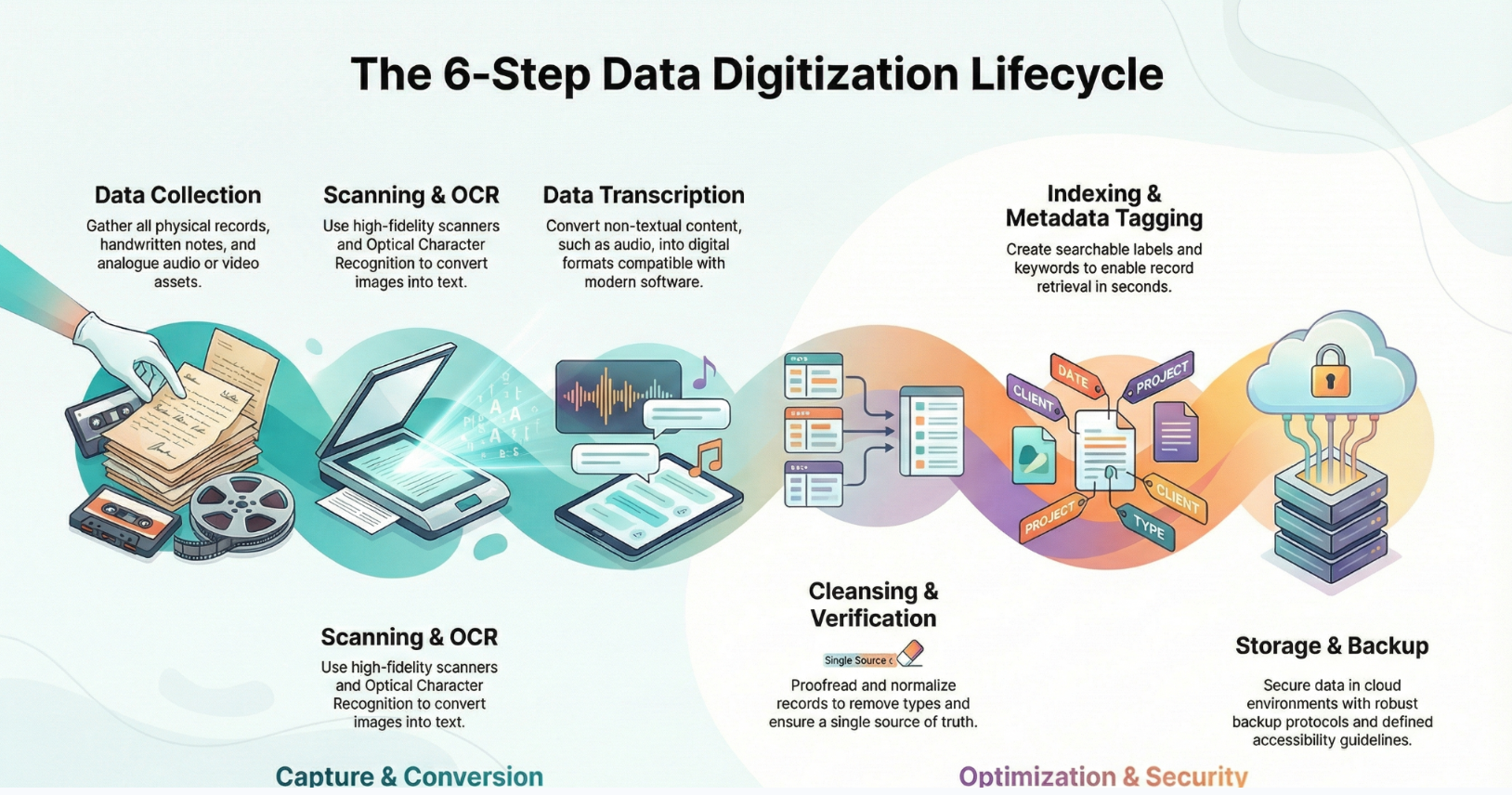
The Step-by-Step Data Digitization Process
To access the benefits of digitisation, your digital records must navigate a structured transformation lifecycle. Here are the proven steps to digitise data from papers, simplifying the process:
Step 1. Data Collection
The very first and foremost step is collecting records. Gather all physical/printed records, handwritten notes, and analogue audio/videos.
Step 2. Scanning or Data Entry
Up next is scanning, which needs high-fidelity scanners and Optical Character Recognition (OCR) technology. These technologies help you capture the images, tables, or any other records and convert them into text. Follow a practical approach to digitize data, which includes OCR technology. It recognises all documents in writing and picture formats. For complex tasks, many companies choose to digitise benefits in business by outsourcing to manual data entry specialists or copy-pasting.
Step 3. Data Cleansing & Verification
This step briefs the accuracy of converted and refined records. In simpler terms, this step ensures the database is free of typos and duplicates. This step includes data cleansing, which involves proofreading, normalisation, enrichment, integration, and data validation to maintain a “single source of truth”.
Step 4. Indexing and Metadata Tagging
This step starts with indexing, which means streamlining the records in sequence and under specific titles. Data specialists create searchable labels or tags. These tags behave like keywords, enabling you to pull up specific records in seconds. All in all, this process makes searching, categorisation, and retrieval way easier.
Step 5. Storage and Backup
Now this step transforms data in a secure cloud environment with robust backup protocols to prevent accidental loss. In this stage, authority & accessibility guidelines are also defined as to who could be able to access that record. This action secures sensitive details.
Step 6. Data Transcription
This is basically associated with the conversion of non-textual content, such as images and audio, into digital formats compatible with modern software. Then, some advanced software and hardware are deployed to make this process effortless.
Why It Matters: The Role & Significance of Digitized Data
So! Why is this shift so crucial? Every department wants to know how it impacts them. Here are the reasons:
-
Ultimate Preservation
Research states that 71 publicly disclosed security incidents took place in September 2023, which led to the loss of 3,808,687,191 records. And this number is added to the yearly loss, which is measured at 4.5 billion. So here, digital perseverance is vital and the only way to make historic or sensitive values immune to vulnerability. Unfortunately, the perseverance proves inadequate in many cases, which results in bad or unrealistic decisions.
-
Universal Accessibility
All want to move away from the handling of files, folders, and lockers. These days, servers and virtual spaces are available to securely and easily access information that you have saved online. It promotes collaboration and in-depth analysis, which is helpful in data science. Outsourcing companies leverage this facility for data extraction and then processing.
-
Effortless Search & Retrieval
How daunting it was to manually search any document in racks or files. Indexing of digital records eliminates the “daunting manual search”. With tags and indexing, every piece of information can be made searchable effortlessly and quickly. This practice enhances productivity and reduces the turnaround time for analysis.
-
Advanced Data Analysis
Analysis refers to getting deep into the insights of the database and making strategies or informed decisions. With online accessibility, a data analyst can easily leverage AI tools to extract insights from digital records and make smarter, valuable data-driven strategies.
-
Space and Cost Efficiency
Digitisation is to become paperless, which eliminates costs associated with physical storage. Digital data is indeed weightless and can be stored on servers and even migrated across the globe in seconds. Additionally, you won’t have to chew iron pills for retrieving any set of records. It’s effortless when you have digitised records.
-
Enhanced Security
It’s certain that paper can be burnt or stolen. And digital data can be encrypted. Encryption and other robust security measures, like installing anti-viruses, can prevent this tragic incident during processing. And by defining authority, you ensure that only the right people see that sensitive record.
Applications of Data Digitization
Since digitisation has been in trend for the past few decades, its reach can be seen in various industries. Here is an overview of this:
Business and Administration: The biggest impact is seen in the corporate world, where entrepreneurs and the workforce enjoy the speed and efficient productivity while working on digital records and handling data management effortlessly.
Healthcare: Hospitals and clinics produce a tonne of paper-based scanned images, X-rays, and reports to capture data automatically. Now, they have started shifting them to their websites, where patients can access them without standing in long queues. It has also helped in medical billing processes.
Research and Education: Schools and educational institutes have already shifted their classes online and made their academic resources, research papers, and textbooks available over the internet.
Government: Various governments have become the biggest beneficiaries of digitisation technologies. Their official records, forms, and documents are now accessible online, which defines their streamlined public services.
Challenges and Considerations
For sure, the advantages of digitisation are vast. But businesses must consider:
- Technical Expertise: Digitisation requires specialists to manage this process while handling sophisticated conversion (OCR) software.
- Quality Control: Blurred pages leading to inaccurate data can be the biggest struggle during scanning.
- Scalability: Digitisation needs a clear budget to secure cloud infrastructure and AI-driven data security governance.
Turn paper chaos into secure, searchable digital data fast, accurate, and scalable.
Conclusion
In today’s digital age, digitalisation is introducing a transforming force to make all associated systems and workforces agile. Its potential for holding information and making it immortal is a big cutting edge, which makes it reliable and the most useful innovation. To get insights into it, consult our certified data digitisation service expert to evaluate your current data transformation needs for converting data into digitised records. This process makes corporate processing simpler, more streamlined, and structured via automation.


Post Comment
Your email address will not be published. Required fields are marked *