

Outsourcing: Types, Importance, Advantages and Disadvantages


Outsourcing means renting out skills and knowledge. It brings two companies enter into an agreement, wherein one performs tasks, handles operations and provides with services, including core and non-core, for another one.
It has been a trading fashion since the time of the Second World War. At that point of time, commercial entities started contracting out business processes (like payroll processing, claim processing), core and non-core functions like manufacturing, call center support etc..
A company can hire a foreign company or a domestic firm. Formally, hiring a virtual assistant in abroad is offshoring outsourcing or nearshoring outsourcing, as Eminenture lends business process outsourcing solutions. It determines relocating a business practice to a distant land or nearby geographic location. Generally, all companies solely undertake a variety of operations within their own infrastructure.
Offshoring Vs Offshore Outsourcing:
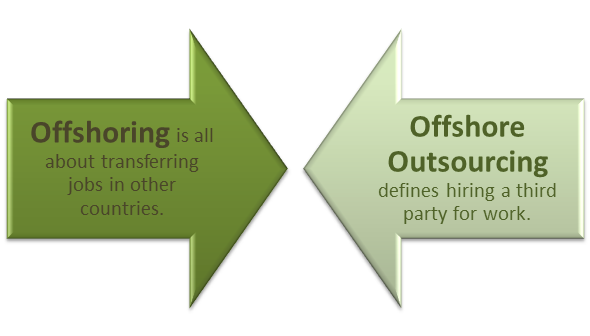
Offshoring: Sometimes, the concept of offshoring outsourcing interferes with offshoring. Actually, offshoring refers to contracting its own subsidiary in foreign.
Offshoring Outsourcing: It determines the practice of hiring a third party or external organisation to take on non-core business activities of the seeker.
Types of outsourcing:
- Print and mail outsourcing: To contract back office outsourcing for executing printing and mailing services directly from a desktop or web interface.
- Marketing outsourcing: To speed up lead generation and conversion through remote assistance
- Knowledge process outsourcing: To effectuate business intelligence driven from the real-time data assessment of a niche through professionals and experienced players.
- Business process outsourcing: To deploy another organisation for backend services, like customer support, for managing non-core competencies.
Advantages and Disadvantages of Outsourcing:
Apart from economic solutions, outsourcing has a few more benefits of outsourcing.

- On getting assistance from a third party, you are left with free resources like personnel and facilities. You can divert them to core competencies or new projects for harvesting gold.
- Quick turnaround time lets you to streamline production. Thereby, you gain a lot of time to devote on expansion plans, enhancing values and innovations.
- You come across current & upcoming trends to integrate in your core competencies.
- Customer support, a non-core activity, can open thousands of opportunities for upselling and cross selling. Despite being blindfolded to it, an entrepreneur can tap on his customer behavior via helpdesk report analysis.
As far as its disadvantages are concerned,
- You may suffer a massive loss of your proprietary data or sensitive information. It certainly happens when you reach an outsourcing agreement ignoring confidentiality and privacy clause.
- The loss of data, let’s say of your leads, can be a gain for your business rivals. Your virtual assistant may sell them out to your competitors. Consequently, it causes a big blow to your dreams of attaining leadership and competitiveness.
- Quality may decline, in case you remain unattended to the performance of your outsourcer. It casts hard-to-recover dent in your business performance.
- An ineffective and inconsistent coordination can end up in affecting quality, which can degrade your company’s rapport.
- It threatens the job security of the in-house workforce. Even, the inhouse teams remain underpaid due to BPOs and KPOs.
Why do you require outsourcing?
- Penny-pinching (to save capital through contracting for a call process or research by a third party)
- Improve efficiency without undergoing an acid test (through partnering with a third party)
- Gain productivity (through employing upgraded and highly qualified virtual assistant to execute business tasks)
- Quick turnaround time ( delivery of the project/product while beating the deadline through expertise)
- Gain competitive edge ( through deploying adepts and veterans, who are masters in outperforming meticulously)
- Leap on the latest trends (through customer care process analysis)
The bottom line is that the third party is hired because it possesses the efficiency and potential you’re your business functions require. Moreover, you hit the goal at very low cost. Thereby, remote assistance saves enough time to figure out core problems. Not only can you patch them up upon learning, but also can gain competitive advantages in the market. This kind of virtual assistance works the best for the entrepreneurs who don’t have deep pockets. It leaves them with amassed spare time to focus on innovation and value-building.


Post Comment
Your email address will not be published. Required fields are marked *