

A Complete Guide to Data Conversion: Types, Examples & Consultant Insights

The hyperconnected digital world cannot see the smooth data transition from legacy systems to cloud platforms, switching CRMs, or integrating software solutions with this service.
Defining Data Conversion: The Core of Interoperability
Data conversion refers to transforming or restructuring data so it can fit different systems, tools, and platforms. It requires data to shift from existing files or folders to changed databases in the format that you want to meet your system requirements. This process is critically significant to maintain the structure, accuracy, accessibility, and usability of information without compromising integrity.
This process is increasingly in demand as digital businesses often scale operations, upgrade technology, and consolidate data sources for informed decision-making.
Critical Types of Modern Data Conversion
Now, let’s explore various types of data conversion services that assist in achieving different goals. Agentic AI and real-time analytics form a great combo, enhancing conversion goals faster and smarter than ever before.
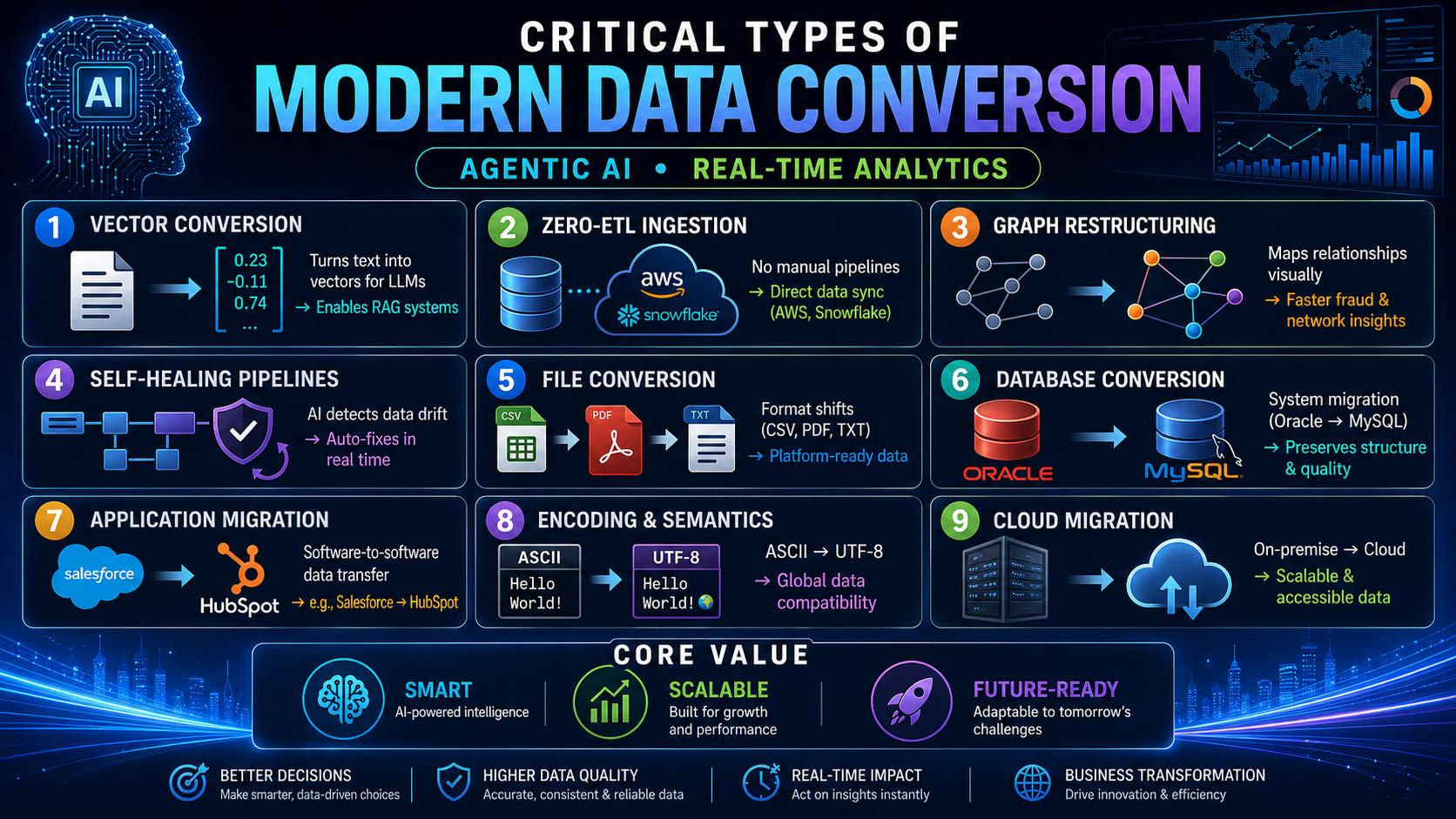
1. Vector Conversion for Generative AI (The LLM Bridge)
With the evolution of LLMs like Gemini, data conversion is no longer restricted to transforming PDFs into Word docs. Now, they need conversion into vectors, which enables large language models to read private data through RAG (Retrieved Augmented Generation).
2. Zero-ETL Ingestion for Schema & Database Transformation
These days, ETL is no longer necessary because of some leading platforms like AWS, Snowflake, and Google Cloud. These platforms exchange data from one point to another without manual conversions. For example, they automatically move data from the sales database to your analytical tool without the need for a professional. It is possible because systems are now able to communicate with one another and hence, data conversion is no big deal.
3. Graph Data Restructuring
However, 'conversion' is a broad term, majorly used for digitising data. But it can also be used to restructure data so it can be understood effortlessly. For example, in fraud detection or social networks, data can be transformed into graphical presentations. This is how relationships among data points can be determined 100x faster, which might be hidden.
4. Self-Healing Data Pipelines
Some modern conversion tools integrate AI-enhanced monitoring. It helps in monitoring the source where the data is extracted from. The software detects the drift. And thereby, it automatically makes changes to the conversion logic without breaking the workflow or defined system.
5. File Format Conversion
It involves converting file formats, such as CSV to XLSX, PDF to Word, or TXT to XML. For example, a finance company may want to transform its data from legacy systems into Google Sheets for modern accounting platforms.
6. Database Conversion
This is a broad range of conversion, which ensures database conversion from one database management system to another (such as Oracle to MySQL). The conversion specialists transform schemas, tables, and fields beforehand to keep relationships and data quality as-is.
7. Application Migration
This is typically related to migrating applications to a new software system. It’s like switching data from Salesforce to HubSpot. Primarily, the focus lies on accurate data interpretation in the new application so it can show better results accordingly.
8. Semantic & Character Encoding
This is a high-level conversion service, which requires data to be encoded from formats like ASCII to UTF-8 so it can support multilingual content and international systems.
9. Cross-Platform Application Migration
This applies to every type of data that one migrates from traditional systems to the cloud after converting it into a massive volume. This service is typically required when your users are multiple and need its accessibility with security and usability.
Real-Life Examples of Data Conversion: Strategic Industry Use Cases
Now that you have understood the type of data conversions, let’s check out its real-life examples:
- Healthcare Sector
Consider the case of hospitals, which require hardcopies to translate into electronic health records (EHRs) in bulk. This data covers patient history, test results, and prescriptions, which are digitized and secure in advanced systems for online accessibility and treatments.
- Retail Industry
As retailers are shifting to e-commerce, it requires the conversion of inventory data from their offline management systems into digital product descriptions, SKUs, pricing, and images as the new platform requires.
- Financial Institutions
Banks often undergo mergers and acquisitions, requiring end-to-end transactional data input. It covers everything from customer account details, and loan history to payment data. These mergers are impossible without seamless data conversion between systems without data loss.
- Government Agencies
Many governments worldwide are digitizing data and converting nationality cards, account details, voter cards, and biometric information into digital formats. This practice makes data stored, searched, and used online for regulatory updates and policy refinements.
The Role of a Data Conversion Consultant: Navigating Complexity
Basic conversion needs can be addressed in-house. However, migrating data to a DBMS or defining a data pipeline to AWS is not possible without consulting with data conversion specialists or experienced companies. These experts specialize in handling ingestion needs, mapping, and transforming data with complete security and accuracy across diverse platforms in different formats.
The data consultant technically guides us through these procedures:
- Data Lineage Tracking
Assessing where the connected data comes from, discovering its formats, and defining a proven conversion strategy for disruption and risk-free transformation.
- Premigration Cleansing
The keen eyes of an experienced data conversion consultant quickly analyze old data fields for restructuring while ensuring no loss of data in the transition. These professionals also validate whether the data is inconsistent and erroneous. Simply put, these professionals guide in eliminating “garbage in, garbage out” via AI-guided data cleansing.
- Regulatory Compliance
The sensitivity of data makes its security a pressing concern. The consultant always prioritizes following compliance standards like GDPR, HIPAA, or PCI-DSS to take place during all transitions
- Testing & Optimization
Before finally making data live on the preferred digital space, its quality is rigorously tested to discover issues early for quick fixes.
- Ongoing Support
Many consultants offer post-conversion support to administer issues, document, and maintain databases where required. His support or guidance in navigating risks such as data loss, misalignment, or corruption.
Best Practices for Secure Data Conversion
The data conversion process is successful if businesses follow these practices.
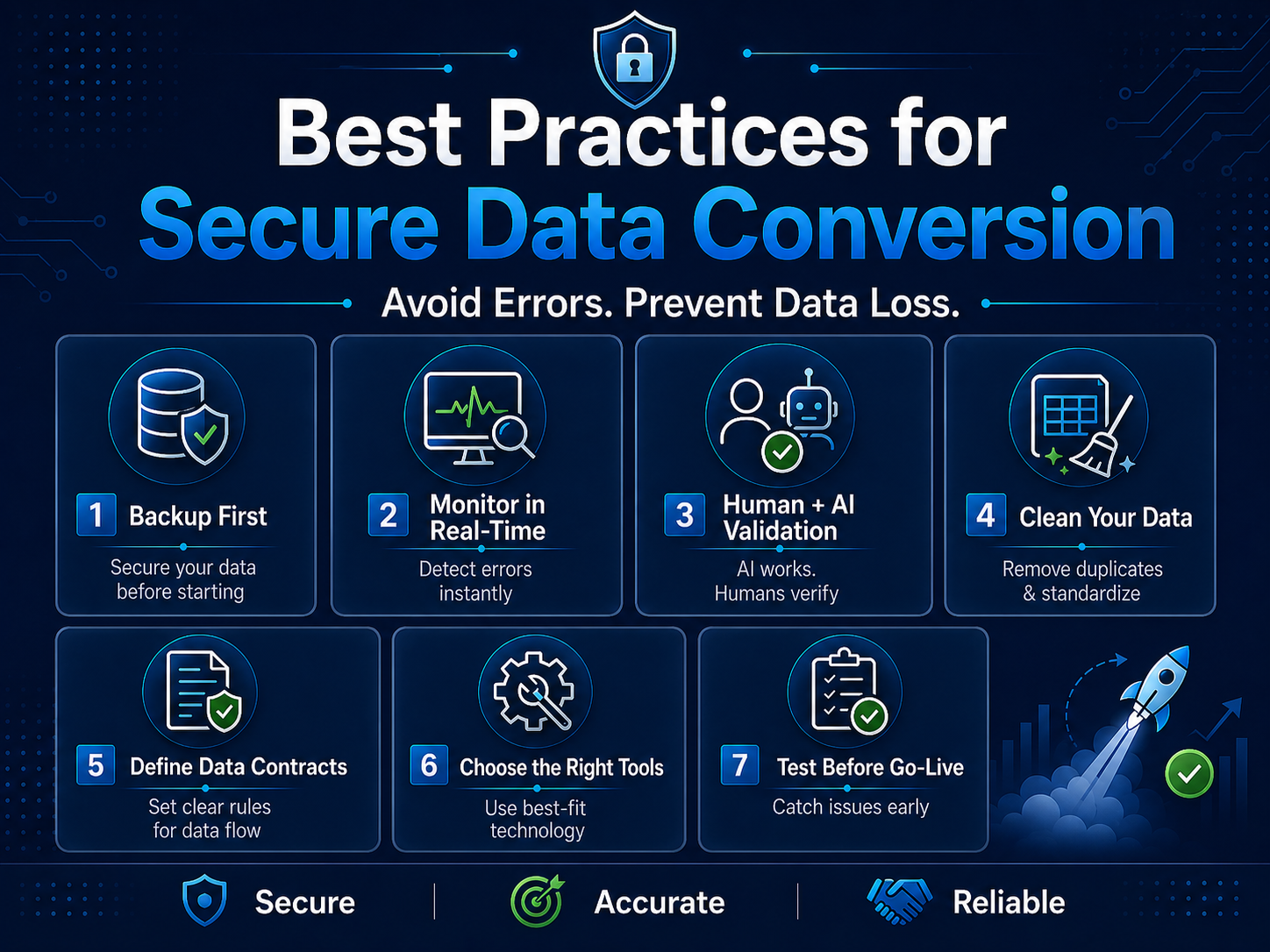
1. Adopt a "security-first" Backup
Backup is the safe side whenever the conversion is initiated. It prevents data from unexpected issues or losses.
2. Prioritize Data Observability
Leverage tools to see if there is any error in the data pipeline in milliseconds during the conversion.
3. Execute "Human-in-the-Loop" Testing:
Though AI is there to take care of complex conversions, human experts must be there to validate the results before going "live".
4. Cleanse Your Data
To maintain data hygiene, experts suggest removing duplicates, standardizing formats, and enriching data for complete entries. With this practice, the problem of garbage in and garbage out does not hamper smooth conversion.
5. Implement "Data Contracts"
While defining clear rules between the sender and the receiver, it helps in discovering the goal behind data transformation, which can be associated with upgrading systems, improving data compatibility, etc. This clarity helps in quickly anticipating & preventing broken pipelines.
6.Use the Right Tools
The clarity to choose the perfect-fit technology is a must. So, choose the suitable tool right from ETL to API integration.
7. Testing
Whenever you convert, test in the testing environments so any mismatch, missing values, and structural issues can be discovered before the data is deployed.
Conclusion
Data conversion may seem like an easy process, but it is indeed critical. This process can be smooth and straightforward with the support of a data conversion consultant or an outsourcing company that has been doing this heavy lifting for years and is also ISO certified. Their experience serves as a valuable source of expertise, offering strategic insights during his consultancy. It is simply because they use the aforesaid best practices and guidelines to avoid any discrepancies or data loss.


Post Comment
Your email address will not be published. Required fields are marked *