

Business Intelligence Trends that Will Make Noise in 2026

Did you know that Business Intelligence (BI) has started making significant noise across the corporate world? In the modern business community, BI is highly appreciated for its ability to collect, analyze, and utilize crucial niche data within minutes.
Of course, data is extremely important and a must-have to make groundbreaking decisions for business intelligence. Let’s introduce you to the top business intelligence trends that are likely to revolutionize the industry this year.
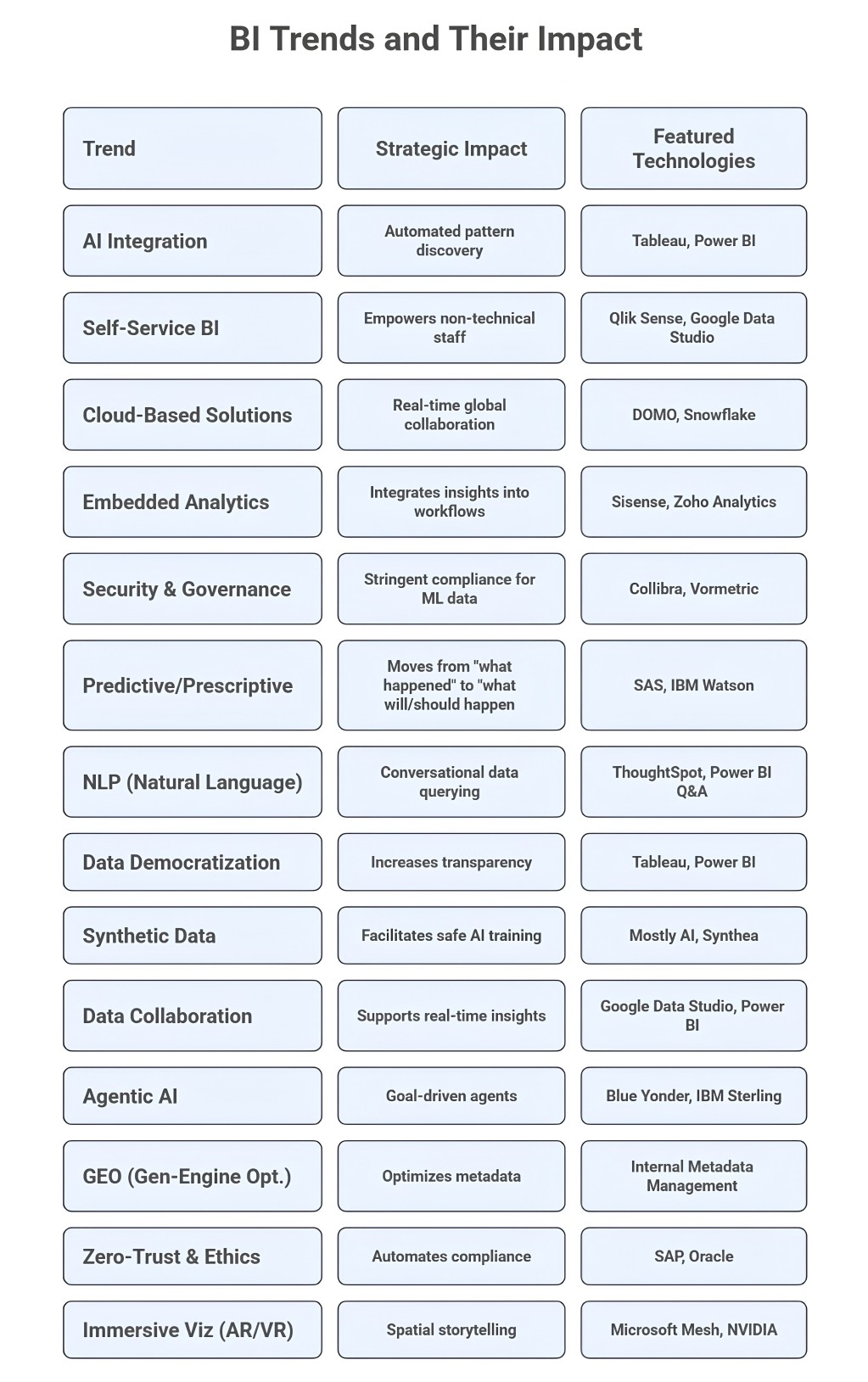
Core BI Trends
Trend 1. How is Artificial Intelligence (AI) Integration Evolving?
Artificial intelligence (AI) has been the talk of the town and continues to carry this momentum into the development of BI. As AI refines itself, more businesses incorporate it for making crucial and enhanced business decisions. AI-driven business intelligence is a standard to embrace across industries. To support this, Sigmoid Analytics reported that over 50% of enterprises will employ AI tools for real-time decision-making by 2027.
Tableau and Power BI have already entered the corporate mechanism by simplifying analysis and tapping into unseen BI trends and insights into the future. These advanced AI capacities allow businesses to discover patterns and anticipate decisions without waiting for manual analysis. So, this digital era becomes a revolutionary year for evolving a refined version of BI.
Trend 2. The Rise of Self-Service BI Tools
Self-servicing is convenient and minimizes conflict between departments. The use of self-service BI tools is on the rise because of their ability to automatically serve corporate entities that may lack technical knowledge of data engineering or accessing sensitive details to analyze.
For this purpose, they no longer require dedicated IT teams and data engineers to guide them. This independent solution speeds up the decision-making process and also empowers professionals to leverage data-driven strategies or solutions. Let’s consider the case of Qlik Sense and Google Data Studio, which automatically create interactive reports and dashboards without human intervention, allowing unskilled employees to automate their processes for faster results.
Trend 3. Why are Cloud-Based BI Solutions Essential?
Cloud-based BI solutions will take businesses to the next level. They integrate flexibility and scalability with a lot of options that save hard-earned money. Entrepreneurs expect cloud BI platforms to become popular. Organizations aggressively rely on hybrid and multi-cloud strategies to support remote teamwork in real time. This is how crucial decisions will be extracted within a few minutes, but not in weeks or months from anywhere in the world. This style of working will bring corporate communities closer and enhance their efficiencies.
Let’s take an example of DOMO, which is a leading cloud-based BI platform. It makes data integration, visualization, and reporting super convenient by catering to a wide range of business users, regardless of organization size.
Trend 4. Driving Efficiency with Embedded Analytics
Analysis defines business intelligence for your applications and workflows. Embedded Analytics allows data collection software to have native analytics properties, helping businesses streamline processes and deliver an excellent user experience. This year will witness more software adapting to these features, enabling employees to interact with data insights without switching platforms. Tools like Sisense and Zoho Analytics already guide users in improving productivity through real-time insights.
Trend 5. Prioritizing Data Security and Governance
Data collection is the requirement for revolutionary solutions like machine learning (ML). Because data is precious, its security cannot be compromised. Data protection technologies are a primary focus as compliance becomes more stringent. Solutions like Collibra and Vormetric Data Security are perfect examples of how businesses secure their data for accurate BI outcomes.
Trend 6. Predictive and Prescriptive Analytics: Beyond Traditional Reporting
Forecasting is gaining massive momentum. It cannot be imagined without predictive and prescriptive analytics.
- Predictive Analytics: Uses historical data to filter future outcomes.
- Prescriptive Analytics: Refines the specific steps and actions needed to achieve those goals.
Businesses rely on tools like SAS Analytics and IBM Watson Analytics to become proactive rather than reactive in forecasting challenges and opportunities.
Trend 7. The Power of Natural Language Processing (NLP)
Natural Language Processing (NLP) is the artificial ability of computers to understand human language. Its integration with BI tools makes data querying simpler; users can simply "ask" their data a question. Microsoft Power BI Q&A and ThoughtSpot offer search-driven analytics powered by NLP, a trend that will only grow more aggressive this year.
Trend 8. Embracing Data Democratization
Democratization of data simplifies data analytics by making it accessible to all stakeholders, not just data scientists. A significant shift toward democratization ensures that decisions are transparent and accessible to everyone. Tools like Tableau and Power BI lead the charge in creating interactive reports that anyone in an organization can understand.
Trend 9. Training Models with Synthetic Data
Synthetic data is the imitation of real-world data that excludes personally identifiable information (PII). This data is a core part of BI strategies because it encourages safe training for data-driven models. Mostly AI and Synthea are currently leading the way in generating data for machine learning.
10. Strengthening Data Collaboration
As BI becomes more collaborative, businesses are adopting tools that allow teams to work together on analysis in real time. Amidst a hybrid work culture, sharing insights via tools like Google Data Studio and Power BI ensures that team-based decision-making is possible from any location.
Trend 11. The Era of Agentic AI and Autonomous Workflows
The evolution of AI has inclined corporate communities toward adopting agentic AI. It’s an advanced version of a standard chatbot, which is goal-driven. A company, let’s say, wants to reduce supply chain latency by 10%. It selects IBM Sterling Supply Chain Suite or Blue Yonder Luminate Platform for independent planning, reasoning, and execution of the necessary data steps across multiple platforms.
These and many other tools transform week-long analyst tasks instantly while revealing the root cause. Trend 12. Generative Engine Optimization (GEO) in BI
Agent AI would deliver better results if the internal metadata were optimized, current, and hygienic. This action drives business leaders to use conversational AI, which finds and interprets the right insights accurately from the optimized internal data.
So, the shift from searching for a dashboard to “asking a shopping agent for a market share report” is obvious.
Trend 12. Zero-Trust Data Governance and AI Ethics
To prevent lots of malicious attempts at hacking & the rise of autonomous agents, data security has become non-negotiable. So, businesses need a zero-trust model, which is based on “never trust, always verify” ideology. Additionally, data governance is no longer constrained to paper-based files.
Now, autonomous compliance is the need for the hour. It is available with vendors like SAP and Oracle that automatically track AI-generated conclusions. Also, these vendors strictly follow global compliance like GDPR or local laws without human oversight.
Trend 13. Immersive Data Visualization (AR/VR)
Now, comprehensibility speaks louder, which visualization provides. With the power of seeing visual data via augmented reality (AR) dashboards, stakeholders can explore insightful 3D data models in a conference room. This revolutionary change allows “spatial storytelling," which enables complex data to be easy to understand, especially for non-technical leaders.
Microsoft Mesh and NVIDIA Omniverse are making this trend normal by offering immersive data visualisation solutions.
Conclusion
The BI landscape is broader and more dynamic than ever. To make it more user-friendly, AI tools are being deeply integrated to power business intelligence. By following these aforementioned trends, businesses can equip themselves with a significant competitive edge in the coming year. They can partner with an ISO-compliant BI outsourcing company like Eminenture, whose knowledge consultants guide them about the latest business intelligence trends and technologies like agentic AI and suggest the best one to enhance customer experiences.


Post Comment
Your email address will not be published. Required fields are marked *