

What is Medical Billing & the Role of Medical Biller & Coder?

Like insurance claims, medical billing is the process of making medical claims from health insurance companies. The customers pay the claim to the healthcare provider or companies for a particular period of time. The companies collect fees, which are meant for providing medical services using a medical bill.
Simply put, medical billing is the service of pooling money for medical services. The medical bill is a claim that an insured person makes to receive medical facilities. With this bill, the insured individual can translate a healthcare service into a medical claim, which is also called a billing claim. Medical billing services are coding and billing, which are done by trained professionals.
What Does A Medical Biller Do?
As it’s a claim-making process, the medical biller uses the codes provided by the medical coder so that he can verify and submit the claim to the insurance company or healthcare services provider.
Then, the follow-ups take place with both the insurer (or the insurance company) and the insured person (or the patient). This is how the medical claim is settled while compensating the medical office. While doing so, the verification happens. The verifier or billing services provider checks if the patient was billed correctly and timely payments have been made. This practice results in receiving reimbursement of the work done by the biller. This is why people search for an authentic biller who can optimize revenue performance for the practice.
What Does a Medical Coder Do?
The role of a medical coder is very significant, as he reads the medical chart of the patient and assesses it to diagnose the patient and further the procedure.
Once done, he puts all diagnoses and procedures in an order according to a national classification system. While doing so, he assigns a specific alphanumeric or numeric code to each diagnosis or procedure.
Key Differences between Medical Biller & Medical Coder
Some people think that medical billing and coding are similar terms. But actually, medical coding is different from billing. In coding, the medical coder reviews clinical records and statements. Then, standard codes are assigned using CPR, ICD-10-CM, and HCPCS Level II classification systems. The diagnoses and procedure codes are collected from medical records or documents like transcriptions of physician notes, laboratory and radiologic results, etc.
On the flip side, the medical biller just processes and follows up for compensations to be sent to insurance companies. He typically assembles and maintains the data regarding diagnoses and procedures. Simply put, he starts and communicates about the procedure of making claims or reimbursements while the coder typically assigns codes and verifies medical invoices & statements. For instance, recording charge data entry, claims transmission, payment posting, and insurance follow-ups define his role. If required, he communicates with general physicians and other healthcare professionals to get clarity on a specific subject. Besides, he is able to understand what the medical record states because of his familiarity with related codes.
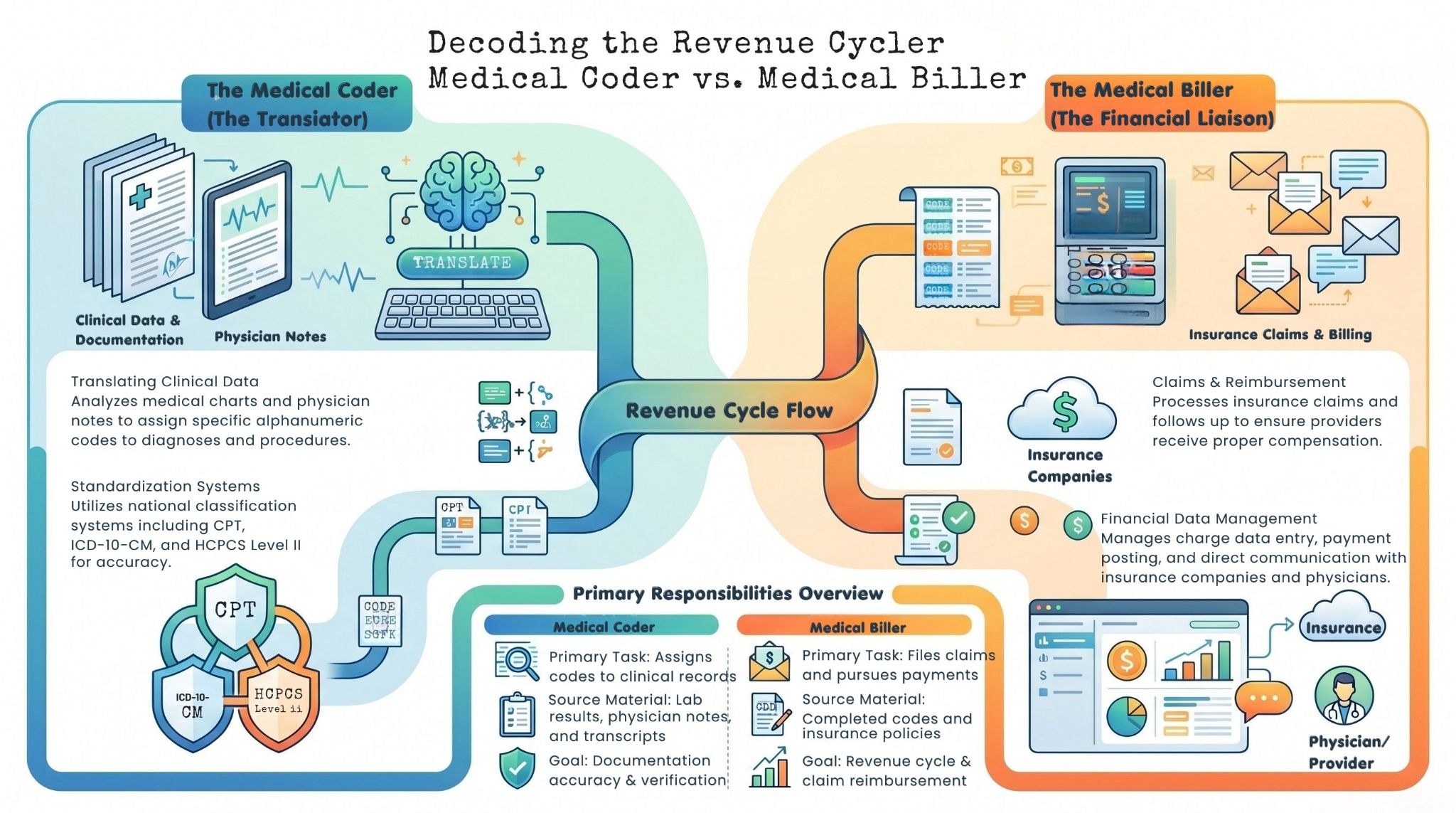
Together, both keep the medical office revenue cycles running smoothly. Here the role of a certified back-office or data entry company is crucial. It can bridge the gap and make the processing smoother.
The Future of Billing: AI & Agentic Automation
- Computer-Assisted Coding (CAC) & NLP Integration
Typically, medical billing is a manual task. The evolution of natural language processing (NLP) has now emerged as its strong competitor. Some NLP engines are advanced enough to pre-read unstructured clinical charts, physician notes, and laboratory results.
- The Process: As NLP is a part of AI, it smartly spotlights key medical terminologies. It develops understanding that simplifies their translation into suggested ICD-11 or CPT codes in real-time.
- Human-in-the-Loop: The role of a human coder is not ended yet. He acts as the final auditor, who verifies the AI suggestions. This synergy minimizes administrative burnout. And virtually, it removes the “clean claim” errors that end up in immediate refusal or denial.
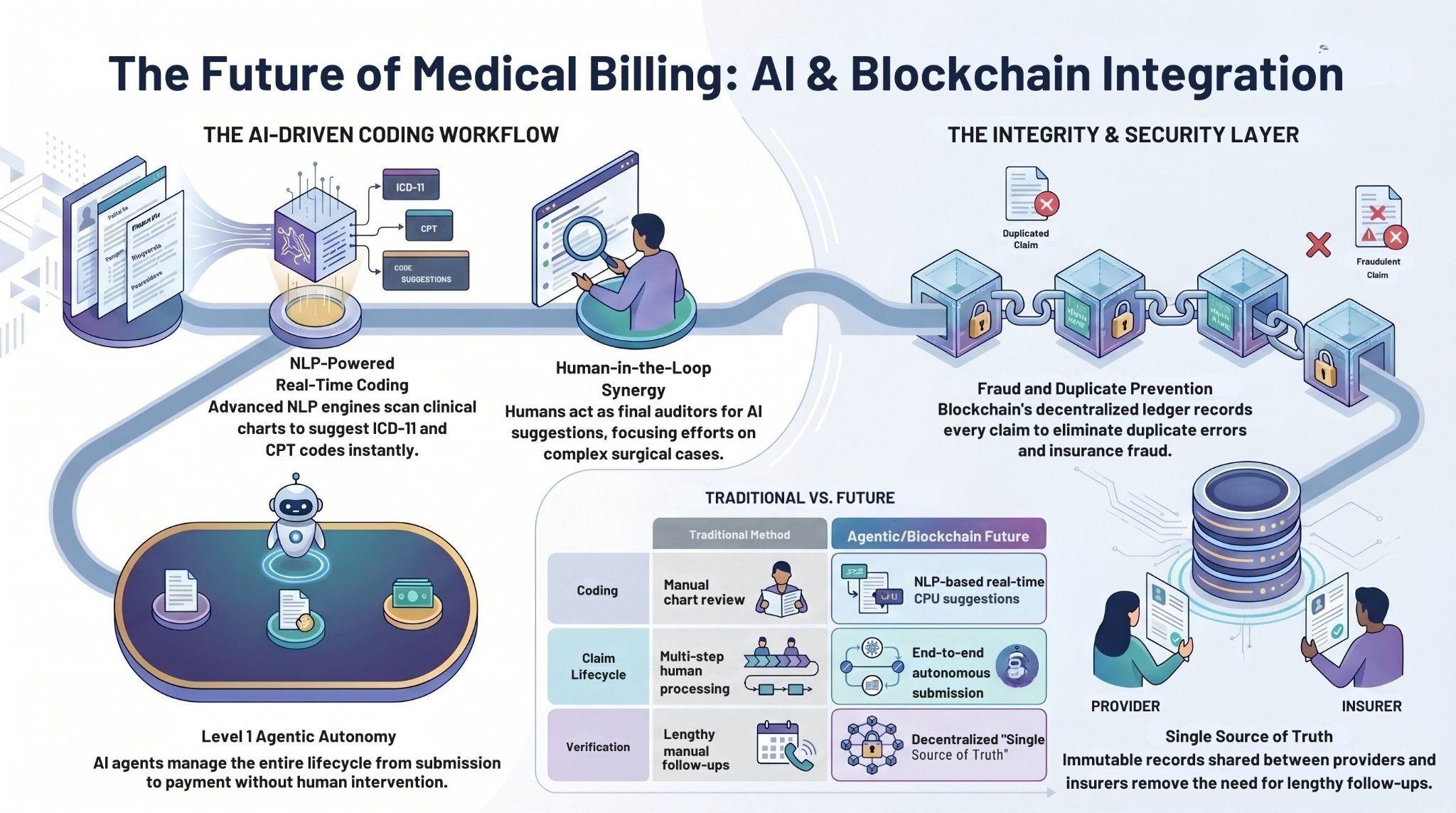
- Autonomous Medical Coding: Deploying AI agents like AKASA, CureMD AI Billing, or Stack AI can handle routine-level claims by optimizing codes, documenting gaps, and tracking claim status.
- Level 1 Autonomy: These tools are necessary for claim processing and payment posting in bulk, as these tools do these tasks autonomously. Simply put, agentic AI manages the end-to-end lifecycle right from coding to submission of the claim without human intervention.
- Strategic Shift: In the meantime, coders focus on complex surgical or multi-speciality cases. These are the cases where humans and their ethical judgement are irreplaceable.
- Blockchain for Claims: Blockchain is one of the proven ways to combat the rising costs of insurance fraud and administrative burdens. It helps in managing decentralized ledgers to prevent "duplicate claim" errors and insurance fraud. In simple words, it helps in settling the process without glitches.
- Fraud Prevention: Since this process records every claim on a decentralized and immutable ledger, it completely avoids the problem of duplicate claims. Also, the system can instantly audit if a specific service or processing has already been done.
- Transparency: As it creates a single source of truth between the healthcare provider and the insurance company, the reimbursement cycle and lengthy follow-ups are not required.
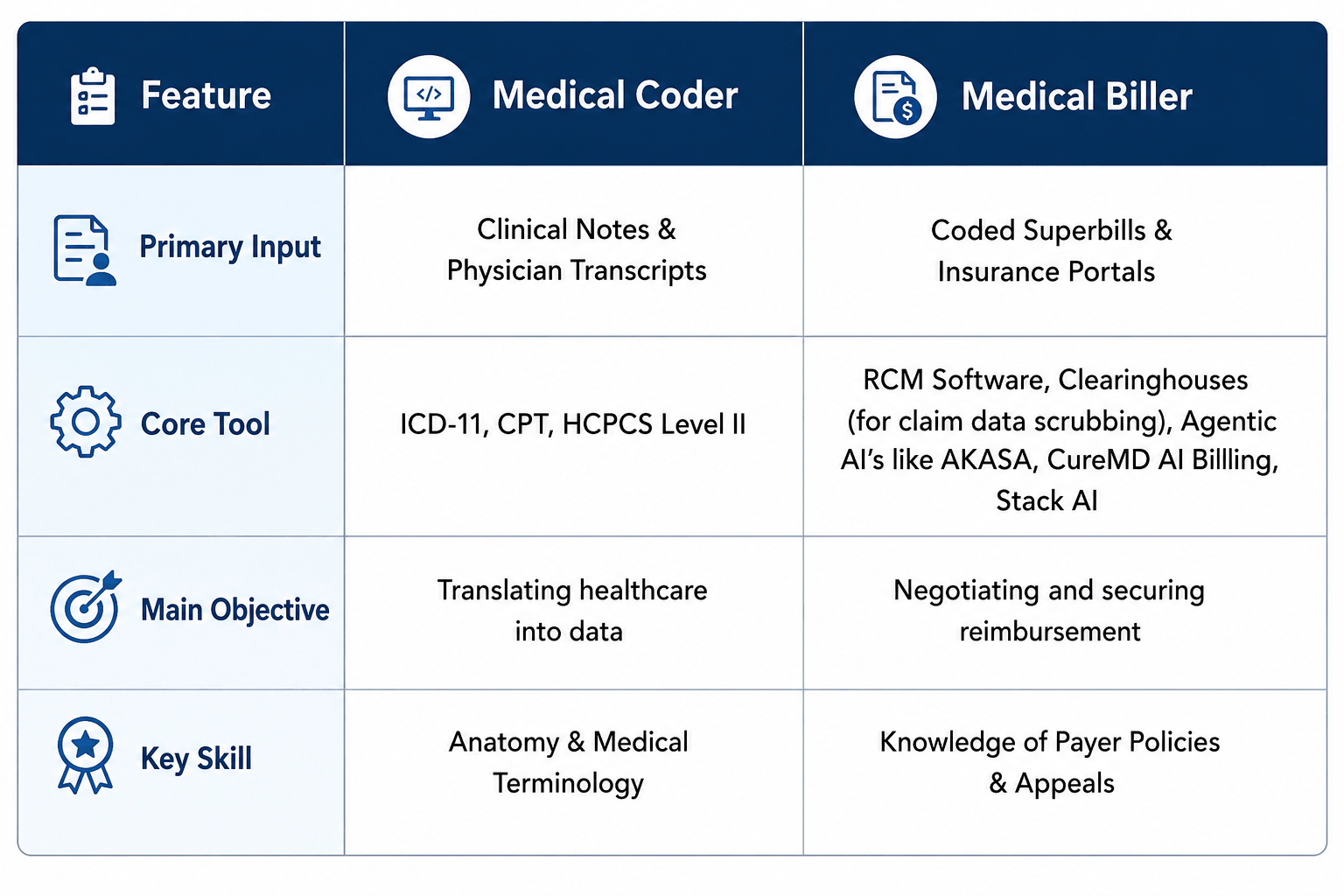
Comparative Analysis (The Biller vs. Coder Matrix)
Conclusion
Medical billing is indeed the process of settling medical claims. For sure, the data states that almost 30% of claims are rejected when first submitted. But the bridge-like role of an outsourcing data entry company can help in establishing the synergy between a certified coder and an expert biller. It is the only way to maintain a healthy and smooth revenue cycle management. Specialized companies like Eminenture can be hired to ensure that technology and human expertise work together to minimize days in accounts receivables.


Post Comment
Your email address will not be published. Required fields are marked *